

Retail has never been short on new technology. The more difficult question is whether that technology improves the shopper’s experience and earns its place in the store. Digital integration is a good example.
Screens are becoming increasingly common across grocery and retail environments, from shelf-edge technology and digital endcaps to interactive product education and large-format brand experiences. But adding a screen to a fixture doesn’t automatically make the fixture more effective – or the investment justified.
The better question is: What can digital integration accomplish that the physical fixture cannot, and can it do it without compromising the fixture’s primary purpose? We recently had an opportunity to see that question answered particularly well.
Colony Display designed and manufactured a Keurig Dr Pepper beverage end cap incorporating a digital header for Kroger, debuting in a store in Bartonville, Texas. The most interesting thing about the installation wasn’t simply that it included digital content. The digital integration didn’t eliminate a single SKU. That distinction matters.
The Store Is Still a Store
In the enthusiasm surrounding digital integration and retail media, it can be easy to forget that the fundamental economics of a physical store haven’t disappeared.
Shelf space matters. Inventory matters. Facings matter. Replenishment matters. And in grocery especially, a fixture still needs to hold and efficiently merchandise a substantial amount of product. Digital should complement those functions rather than compete with them.
In the Keurig Dr Pepper application, the screen occupies the header area, creating another communication layer without taking productive merchandising space away from the products below it. The fixture also accommodates a pallet drop in the lower section to simplify replenishment, while power wings provide additional facings. Digital was added without sacrificing the fundamentals of grocery merchandising: inventory capacity, shopability and replenishment.
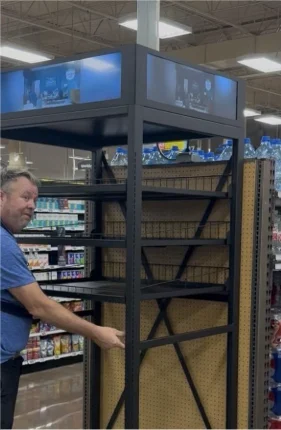
The fixture can continue doing what a fixture is supposed to do – hold inventory, organize merchandise, facilitate replenishment and make the product easy to shop – while the digital component does something the physical structure cannot.
The digital layer can move, attract attention, change at any time, respond to seasonality and even be localized by market or store. And it can communicate something different tomorrow without requiring the fixture itself to change.
That is where digital becomes more interesting.
Kroger Is Thinking Beyond Screens, Too
This philosophy is showing up elsewhere in Kroger’s store environment.
When Kroger Precision Marketing expanded its in-store digital capabilities, it made an important distinction: the strategy was not simply about adding screens to stores. The digital touchpoints were designed to be integrated into purpose-built fixtures and to feel native to the retail environment. That distinction matters. When technology is considered as part of the fixture and the shopper experience from the beginning, it becomes another component of the merchandising system rather than something added to it later.
That approach also reflects a broader shift in how Kroger views the physical store. Kroger Precision Marketing has described the store as a critical touchpoint even as shoppers incorporate more digital and e-commerce into their routines, with an opportunity to blend digital tools with the tangible advantages of shopping in person.
The shopper research behind that thinking is worth separating from the technology itself. Research from 84.51° cited by Kroger Precision Marketing found that 38% of shoppers were interested in smart carts, 33% wanted more taste-testing stations and product demonstrations, and 25% were interested in digital screens at the shelf displaying advertising, nutritional information and promotions. Kroger Precision Marketing separately identifies digital signage, interactive displays and kiosks among the tools brands can use to create more engaging in-store experiences. The opportunity, therefore, extends beyond simply selling advertising on another screen. Digital can perform a merchandising function.
When Is Digital Worth the Investment? Not Every Display Needs a Screen.
In fact, one of the risks as digital becomes less expensive and easier to deploy is that retailers and brands begin adding screens simply because they can. A store filled with competing motion could eventually become no more effective than a store filled with competing signs.
The strongest applications begin with a specific merchandising problem.
A product may require explanation or demonstration. A new item may need more storytelling than a printed graphic can provide. A food or beverage brand may want to show serving ideas, recipes or different consumption occasions. Seasonal messaging may change several times while the underlying assortment remains relatively constant.
Digital is particularly valuable when the message needs to change more frequently than the fixture does. Consider a beverage display. The physical merchandising architecture might remain relevant for years, while the message moves from football season to the holidays, a new flavor launch, summer entertaining or a promotional event.
Traditionally, each change might involve new printed graphics, production, shipping and store-level execution. A digital component changes that equation. The content can become temporary while the merchandising platform remains permanent.
That Fits a Larger Shift in Fixture Investment
We have discussed this previously in Colony Retail Insights: retailers and brands increasingly have reason to think about fixtures as longer-term platforms rather than single-program assets. The old model of designing a highly specific fixture for one product assortment, one campaign or one store configuration can become expensive when merchandising strategies change.
A better long-term investment is often a fixture engineered for change. Adjustable components. Replaceable graphics. Modular accessories. Reconfigurable merchandising areas. Materials and construction capable of surviving multiple resets.
Digital can become another part of that same strategy.
Instead of asking, “How long will this digital display last?” the more useful question may be: “How many different jobs can this fixture perform during its useful life?” That changes the economics considerably.
Design the Fixture to Outlive the Technology
There is an important caveat. The physical fixture and the technology installed in it probably won’t have identical life cycles.
A well-engineered metal or wood fixture may remain perfectly functional after a screen, media player or communications technology has become outdated. Commercial display technology continues to improve in durability and suitability for demanding retail environments. Even so, designing the entire assembly around today’s electronics can create tomorrow’s obsolescence problem.
The better approach is to make the technology serviceable and, where practical, replaceable. Screens can be mounted rather than permanently embedded. Media players and power supplies can remain accessible. Cable management can anticipate maintenance. Components can be replaced without dismantling the entire fixture. The goal should not necessarily be to build a fixture that permanently contains a particular screen for most retail environments.
Build a durable merchandising platform with an upgradeable digital layer. That distinction can significantly extend the useful life of the overall investment.
Repurposing should also be considered at the beginning of the design and engineering process, not at the end. If the merchandising structure can accommodate changing assortments, graphics and digital content—and the electronic components can be serviced or upgraded – the same physical asset may support multiple campaigns, product introductions and seasonal programs. That is a very different investment proposition from building a display around a single moment in time.
The Technology Behind the Screen Matters
Digital integration also involves considerably more than purchasing a display. Depending on the application, a deployment may require a commercial-grade screen, media player or integrated system-on-chip, power, connectivity, content-management software, mounting hardware and a plan for remote monitoring and support.
Commercial digital signage equipment matters because retail environments can demand long operating hours and reliability that consumer televisions were not designed to provide. Remote device management also becomes increasingly important as deployments scale. A failed screen in one store is an inconvenience. A network of hundreds of screens without centralized visibility becomes an operational problem.
Content management is equally important.
Who can change the message? Who approves it? Can content be scheduled? Can different stores receive different content? What happens if connectivity is interrupted? Who knows when a device goes offline?
These questions may not be visible when a shopper walks past a digital display, but they have a major effect on the true cost and scalability of the program.
Costs Should Be Evaluated Over the Life of the Program
This is also why comparing the price of a digital screen with the price of a printed sign doesn’t tell us very much.
The appropriate calculation is closer to total cost of ownership.
AVIXA, the professional audiovisual industry association, has made a similar point in its guidance on digital signage: upfront price shouldn’t be confused with the overall cost of the solution. The value needs to be considered against the objectives and useful life of the program.
For retail, that calculation can include hardware, fixture integration, installation, software, connectivity, content creation, maintenance and eventual technology replacement.
But the other side of the equation matters too.
How many printed graphic changes could be eliminated? How many campaigns can use the same hardware? Can content be changed nationally without shipping new materials to every store? Can the fixture support a new product introduction next year? Can the technology be upgraded without replacing the merchandising structure?
And, importantly: Did adding digital preserve the space available to sell products? If the answer is yes, the economics become much more interesting.
Digital Doesn’t Have to Mean Advertising
Retail media networks are clearly accelerating investment in in-store screens, and their ability to connect media exposure with sales measurements is an important development.
But digital integration has applications well beyond advertising.
- It can demonstrate.
- It can educate.
- It can provide recipes or project inspiration.
- It can explain complicated products.
- It can change messaging by season, promotion or occasion.
- It can help communicate information that would otherwise require multiple signs.
Even the humble shelf label is becoming digital. The National Retail Federation has highlighted electronic shelf labels as retailers look to improve pricing accuracy, consistency and operational efficiency.
The common thread isn’t the screen. It is adaptability.
Perhaps the Future Isn’t More Screens
There is a temptation to imagine the future store as a sea of digital displays. That may not be the best outcome.
If everything moves, movement eventually stops being disruptive. If every fixture contains a screen, the screen itself stops being interesting. We have all seen deployments where too much digital simply became another form of visual clutter. The more compelling future may be a store in which digital appears selectively – where movement, information, demonstration or rapidly changing content can accomplish something static merchandising cannot.
That brings us back to the Keurig Dr Pepper installation at Kroger. The interesting part isn’t that a screen was added to a beverage display.
It’s that another communication channel was created without removing the merchandise the shopper came there to buy.
And because the message can change while the merchandising platform remains in place, the same investment can potentially support many different moments in the life of the brand. For programs deployed across multiple locations, that adaptability becomes even more valuable when paired with coordinated rollout logistics.
That is when digital stops being an accessory. It becomes part of the fixture strategy.